Why Your Dog Coat Doesn’t Fit (It’s Not Size — It’s Chest Shape)
 Jill Bartlett
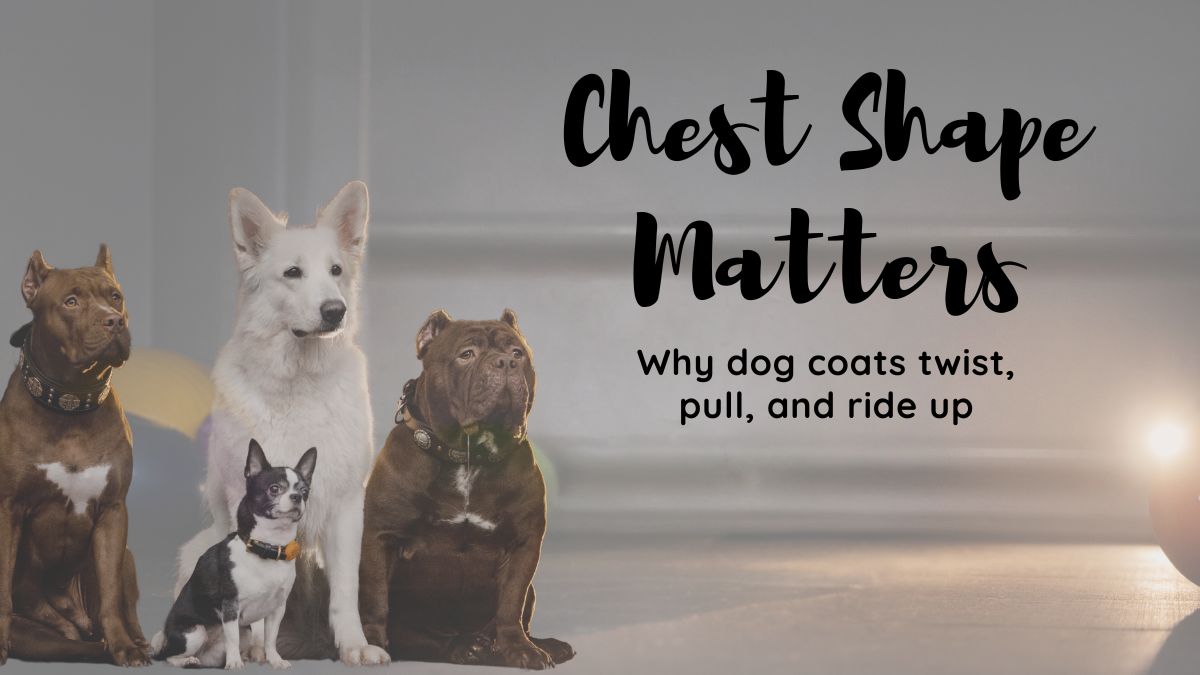
Learn the importance of a dog's chest shape and how a Barrel, Deep, and Round chest shape affects the dog-wear fit.
Most dog coats don’t fail because of bad sewing...
They fail because the shape of the dog doesn’t match the shape of the pattern.
You can take perfect measurements.
You can follow the pattern exactly.
And the coat still:
- twists to one side
- rides up at the back
- pulls tight across the chest
That’s not a size problem.
It’s a shape problem.
Because when the shape is wrong, the fabric has to go somewhere.
It pulls, shifts, and rotates to release that tension.
And that’s why a coat can look right when your dog is standing…
but fail the moment your dog starts moving.
This is where most people get stuck — because they’re measuring size, not understanding shape.
Why Chest Shape Affects Fit:
Every dog has a different chest structure.
Some dogs are wide and round.
Some are deep and narrow.
Some carry more shape toward the front, others toward the bottom.
Patterns are built for a specific shape.
When your dog’s shape doesn’t match that pattern:
- fabric gets pulled in the wrong direction
- tension builds in specific areas
- the coat shifts to release that tension
That’s when you see twisting, pulling, and riding up.
How Chest Shape Shows Up in Fit:
Barrel Chests:
 |  |
- Shape: Rectangular from the front, square from the side.
- Ribcage: Wider than it is deep.
- Position: Bottom of the ribcage usually in line with or above elbows.
What it looks like:
- Wide across the front
- More rounded through the ribs
What happens in a coat:
- Tightness across the front panel
- Wrinkles or pulling behind the front legs
- Coat may look fine from above but strain from the front
Deep Chests:
 |  |
What it looks like:
- Shape: Oval from both front and side angles.
- Ribcage: Deep and narrow.
- Position: Bottom of the ribcage usually in line or below elbows.
- Narrow from the front
- Drops deeper toward the belly
What happens in a coat:
- Coat rotates or twists during movement
- Fabric gets pulled forward, then shifts backward
- Belly strap doesn’t stay in place
Round Chests:
 |  |
What it looks like:
- Shape: Circular from both front and side views.
- Ribcage: Width equals height.
- Commonality: Most dogs fall into this category.
- More evenly distributed shape
- Moderate width and depth
What happens in a coat:
- Generally easier fit
- But still depends on pattern balance and positioning
If your coat twists, pulls, or rides up…
this is exactly where the problem starts.
I break this down using real examples in my Fit Clinic videos so you can actually see what’s happening and why.
👉 Watch the Fit Clinic here:
https://www.youtube.com/playli...
Why Coats “Look Right” But Don’t Work:
Standing still only tells you size.
Movement reveals fit.
When your dog walks:
- the front legs move forward and back
- the chest expands and shifts
- tension builds where the pattern doesn’t match the body
If the shape isn’t right, the fabric has to go somewhere.
That’s when it:
- lifts
- shifts
- rotates
This is why a coat can look perfect when your dog is standing…
and fail the second they move.
And, this is where most people get stuck —
because they’re measuring size, not understanding shape.
How to Measure Your Dog’s Chest (Properly):
Most people measure the chest girth and think they’re done.
That’s where things go wrong.
If you don’t understand where the chest sits and how it’s shaped,
your measurements won’t translate into a coat that actually fits.
Step 1: Gather Your Tools:
Use a soft measuring tape.
Have your dog standing naturally — not sitting or stretched out.
Step 2: Find the Right Position:
Wrap the tape around the widest part of your dog’s chest, just behind the front legs.
Keep it snug, but not tight.
This gives you your base number — but it’s only part of the story.
Step 3: Find the High Point (Withers)
Locate the withers — draw an imaginary line up from behind the dog'd front legs to the highest point at the base of the neck on the spine.
This is where the coat will anchor.
If this point is off, the entire coat shifts.
Step 4: Measure Front Height:
Measure from the withers down through the front of the chest to where the chest is deepest.
This is one of the most missed measurements — and one of the most important.
Step 5: Identify the Widest Point:
Look at your dog from the front and from the side.
Where is the chest actually widest?
- High and wide → barrel chest
- Lower and deeper → deep chest
This affects where the coat needs space — and where it will pull if it’s wrong.
What These Measurements Are Really Telling You:
You’re not just collecting numbers.
You’re identifying:
- where the chest is widest
- how deep it drops
- how the body is balanced front to back
That’s what determines how the coat needs to be shaped.
How This Connects to Fit Problems:
If your coat:
- pulls across the front
- shifts backward
- twists during movement
Go back to these measurements and look at shape — not just size.
What These Measurements Actually Tell You:
Once you understand chest shape, you stop guessing.
You start seeing:
- where the pattern needs more width
- where it needs more depth
- where balance needs to shift
Small changes in shape create big changes in fit.
This is where most patterns fail — they assume all dogs are built the same.
How Chest Shape Shows Up in Fit Problems:
Different chest shapes create different kinds of fit problems.
If you know what to look for, you can start to connect what you’re seeing in the coat
to what’s happening in the dog’s body.
Here’s how each chest shape typically shows up — and what those signs are telling you:
Barrel Chested Dogs:
What you’ll see:
- Tightness across the front of the coat
-
Pulling or drag lines behind the front legs
- Coat looks fine from above, but strained from the front
What this tells you:
The coat doesn’t have enough width where the chest needs it.
Deep Chested Dogs:
What you’ll see:
- Coat shifts or rotates during movement
- Fabric pulls forward, then slides backward
- Belly strap won’t stay in place
What this tells you:
The coat doesn’t have enough depth or front balance.
Round Chested Dogs:
What you’ll see:
- Fewer obvious fit issues
- Coat tends to stay in place more easily
What this tells you:
The shape is closer to what most patterns are designed for —
but balance and positioning still matter.
Once you can recognize these patterns, you stop guessing
and start understanding what the coat actually needs.
That’s what allows you to move from following a pattern
to making something that truly fits your dog.
The Journey Continues: Withers & Balance:
Chest shape is just one piece.
Fit also depends on:
- where the coat sits at the withers
- how the front and back are balanced
- how the coat is anchored on the body
If those are off, even the right chest shape won’t fix the problem.
Share Your Dog's Unique Chest Shape:
Every dog is different.
Once you start noticing shape, you’ll see why so many patterns don’t work right out of the package.
If you’re unsure what you’re seeing:
- take a photo
- look at it from the front and side
- compare where the width and depth sit
That’s where the answers are.
Want Help Diagnosing Fit?
If your coat is twisting, pulling, or not sitting right,
you can send me your photos and I’ll take a look.
👉 Email: jill@thankdogwemadeit.com
Include:
- front + side photos
- what the coat is doing (twisting, riding up, etc.)
- what pattern you’re using (if any)
I’ll point you in the right direction so you can understand what’s happening.
In Conclusion:
If you’ve ever made a coat that looked right but didn’t behave right…
you’re not dealing with size.
You’re dealing with structure.
👉 Download the measurement workbook and video guide
so you can start seeing what’s actually going on — and fix it.
Categories: : Blog, Pattern Making, Sewing
If you’ve ever made a coat that looked right but didn’t behave right…
You’re not dealing with size.
You’re dealing with structure.
Grab my free Measuring Workbook and Video Guide to start designing better-fitting patterns today.
Join My Mailing List
Sign up to be the first to know about exclusive offers, free tutorials, and new product updates.
I have read and agree to the terms & conditions.

